The “Techlash” Is Asking Good Questions. Who Gets to Answer Them Matters.

Billy Warden
SVP, Strategic Growth
Amira Learning
in Chicago, Illinois
Topics
Educators increasingly rely on education technology tools as they shift instruction, redefine teacher roles, and design learning experiences that reflect how students actually learn. Technology should never lead the design of learning. But when used intentionally, it can personalize instruction, enrich learning environments, and help students master critical skills.
Who gets to decide what technology and AI belong in classrooms, and whose voices are missing from that conversation?
During the pandemic, I was a district leader serving schools on Chicago's south and west sides, and like educators everywhere, my team had to decide when to bring students back into our buildings. We kept our schools closed about as long as any in the country.
Our decisions stemmed partly from passionate advocacy by stakeholders with legitimate safety concerns amid widespread ambiguity and conflicting evidence—concerns I shared.
Looking back, we got it wrong. The effects of extended school closures are now well documented: academic achievement was lower in districts that stayed remote longer, and the losses fell hardest on under-resourced communities, where students were already furthest behind.
That experience taught me a valuable lesson: what can feel like responsiveness to the loudest voices can quietly work against students on the margins. I think about it most now, watching the national debate over technology and AI in schools.
The “techlash” and growing AI skepticism have the potential to spark a watershed moment in K12 education. For years, too many products were sold to schools on glossy promises and little proof. The recent scrutiny should be harnessed to establish basic standards for tech programs vying for sacred instructional time: they must be safe, and they must be backed by rigorous research and efficacy studies. But for the scrutiny to serve every child, two additional conditions must also be in place:
We must trust education leaders with complexity.
We must hear from the whole community, not just the most assertive part of it.
We Must Trust Education Leaders with Complexity
Much of the media coverage frames the debate as a binary: screens or relationships, AI or humans, bans or unfettered access, and on and on. That framing may grab people’s attention, but it sells short some of the most brilliant people I know. Educators make hard calls every day, and holding nuance is part of the job. An educator can understand that some AI can help a student meaningfully practice and that some AI can problematically offload thinking, and that children learn best through human relationships, all at once.
The latest international data shows exactly this kind of nuance. On the one hand, PISA 2025 results, released in September, reveal students who spend extensive time on devices for learning scored well below their peers in science. On the other hand, students who spend no time on devices for learning fared no better. To be clear, I’m not arguing for more screen time: many of us can agree that multiple hours on devices every day isn’t good for kids. Crucially, it is not just a question of total time spent, but of purpose and quality—watching random YouTube videos is not equivalent to engaging in focused, productive practice. That distinction is exactly the kind of nuanced pedagogical call education leaders are trained to make.
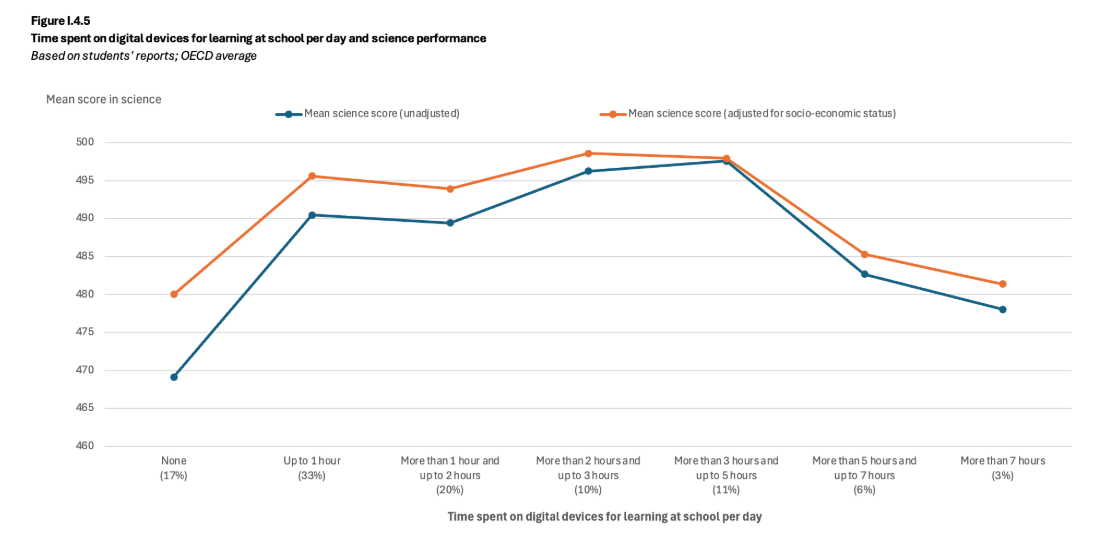
Source: Author's grouping of OECD (2026), PISA 2025 Results (Volume I), Figure I.4.5. Scores adjusted for socio-economic status; middle and upper time bands combined as weighted averages.
We Must Hear from the Whole Community
The stakeholders speaking up today with AI concerns are doing exactly what engaged citizens should. Unfortunately, media coverage of the debate rarely captures the perspectives of a whole community, especially those who typically don't have a voice in these decisions. The parent working a double shift usually isn't quoted in a story. The grandmother raising three kids usually isn't organizing online. But these stakeholders matter as much as the ones who are more visible. And their children are sometimes the furthest behind, and the ones proven instructional programs might help most.
If we miss on these calls, the real risks are blanket decisions that preserve the status quo. National scores are still below where they were before the pandemic, and the gap between our highest- and lowest-performing students keeps growing.
That doesn't mean there's one right answer. For some communities, tight restrictions on tech in classrooms may be exactly right, and if families and educators reach it together, it will likely serve them well. Others will land somewhere very different.
In my time teaching and leading in schools, I watched scores of children advance as many as three grade levels in a single year. It never came from one tool or one heroic adult, but from creating the right conditions—especially inclusive partnerships that actively brought in the voices that were often left out.
We find ourselves once again facing widespread ambiguity, conflicting evidence, and legitimate safety concerns. But if the current techlash encourages us to listen to every corner of our communities and rely on rigorous data rather than just reacting to the loudest voices; if it reminds us to trust educators with nuance while engaging all stakeholders, it will have served a vital purpose.
Note: Amira Learning is a paid member of the LEAP Innovations EdTech Design Collective.
Photo at top of tenth graders collaborating on research for a project, by Allison Shelley/The Verbatim Agency for EDUimages, CC BY-NC 4.0
Billy Warden
SVP, Strategic Growth, Amira Learning
Billy Warden has spent nearly two decades in education. He served Chicago’s south and west side communities as a teacher, school founder, and district leader, and now partners with districts across the country to accelerate literacy at scale.