Building Thinking Classrooms? Manage Your Prep Time with AI and LaTeX

Joseph Chaves Lombardi
Mathematics Teacher
High School in the Community (HSC)
in New Haven, Connecticut
Topics

Educators increasingly rely on education technology tools as they shift instruction, redefine teacher roles, and design learning experiences that reflect how students actually learn. Technology should never lead the design of learning. But when used intentionally, it can personalize instruction, enrich learning environments, and help students master critical skills.
Combining AI with LaTeX typesetting can streamline some parts of Building Thinking Classrooms preparation, but the framework relies on teachers' expertise in pedagogy and student engagement that AI can't support.
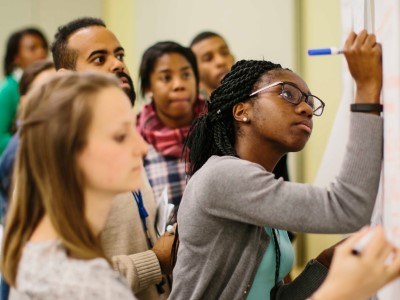
During the 2023–2024 academic year, I was encouraged to pilot a Building Thinking Classroom (BTC). This instructional framework, developed by Peter Liljedahl, emphasizes collaborative problem-solving at vertical nonpermanent surfaces with tasks designed to promote mathematical thinking rather than procedural understanding.
My pilot of the BTC model inspired me because of the outstanding work it produced. However, I was overwhelmed by the amount of labor required—not only to envision each BTC task, but also to create it from scratch. Developing each BTC task required three components: the initiation, instructional task, and consolidation. During the initiation, students are introduced to the task along with important vocabulary and concepts. Enough information is provided to get started, but it is grounded in the idea that students will work through these concepts and build their understanding from scratch, so a fully developed discussion of every topic is unnecessary. Students then complete the instructional task, which can be quite lengthy. The instructional task consists of a sequence of carefully designed problems that help students construct their own understanding through productive struggle and appropriate scaffolding. Finally, this thinking is refined during the consolidation phase, when students review important concepts, questions, and ideas as a class.
Preparing the instructional component is the most cumbersome because it makes up the majority of each BTC task. I realized that if I could find a way to automate even part of the instructional component, I could significantly reduce the time I spent creating BTC tasks. To make that idea a reality, I first needed to understand how AI interprets mathematical notation.
Using LaTeX for Math‑Typed AI Prompts
LaTeX is the standard mathematical typesetting language used in universities worldwide because it produces clean, professional mathematical notation. Although many mathematics educators avoid learning LaTeX because of its steep learning curve, I was required to learn it while writing my master's thesis, which included a formal mathematical proof.
Although LaTeX can be installed locally, I used Overleaf, a free online LaTeX editor that makes it easy to compile and edit AI-generated code without installing any software.
I later discovered that AI not only understands how to write in LaTeX but can also edit LaTeX effectively. A slide that used to take hours to revise and rewrite could be generated in seconds using an AI platform. This realization led me to develop the resource I now use most often in my classroom: a Ready-to-Edit BTC Slide template.
From Ready‑to‑Edit to Ready-to-Implement
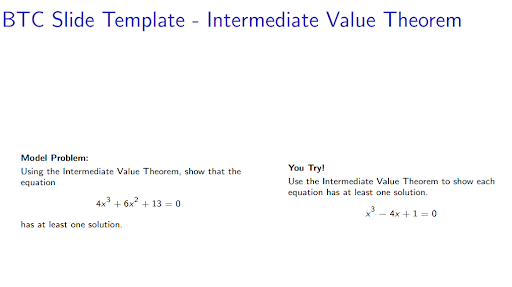
A Ready-to-Edit BTC Slide provides a starting point for educators who want to build BTC tasks quickly. Each slide includes:
A model problem on the left
A "You Try" problem on the right
This structure allows teachers to add scaffolds, extensions, or context after the initial slide is generated. While these slides are not immediately classroom-ready, they dramatically reduce the time spent typing problems manually or recreating similar slides from scratch. AI can also generate solutions, although these often require revision to make them more student-friendly.
Below is an example of a Ready-to-Edit BTC Slide on the Intermediate Value Theorem generated using AI. The output is intentionally simple, but it saves considerable preparation time. Following this example is a Ready-to-Implement BTC Slide—the same slide annotated with scaffolded solutions on the left side of the page.
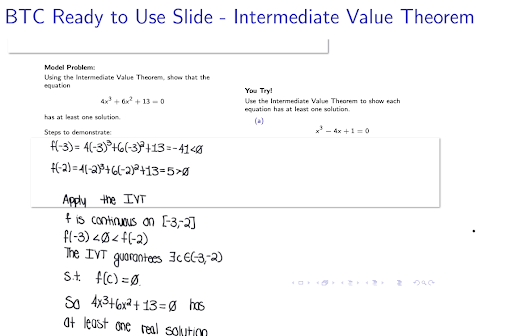
I use AI to rewrite the LaTeX code for this slide when I need to create new slides for other Building Thinking Classrooms tasks.
You can use it too! Follow the steps below to adapt the code in my template to any mathematics topic.
Steps for Generating a Ready‑to‑Edit BTC Slide in LaTeX
Go to overleaf.com.
Create an account (if you do not already have one).
Start a New Project.
- In your AI platform, use the following prompt structure:
“Rewrite the code shared below, tailored to the question shared below.”
Question: (Paste the math problem you want to use.)
Template: (Paste the LaTeX code template.)
Copy the AI‑generated LaTeX code into Overleaf and compile it to test the result.
Check the AI generated work through an expertise lens.
Can AI Generate Solutions for Building Thinking Classrooms Tasks?
As educators begin generating slides using LaTeX, they may wonder whether AI can take the process a step further by generating complete solutions. This is the very same question I asked myself while learning to automate the preparation of my curricular materials. What I discovered is that, although AI can generate accurate solutions, they are not always student-friendly and are often organized differently from how I would present them in my own classroom. In many ways, relying entirely on AI-generated solutions removed some of the authenticity and personalization that I believe are essential to supporting students effectively.
Instead, I ask AI to generate solutions as a reference and then write my own based on how I would naturally teach the problem. This approach allows me to preserve my instructional voice while ensuring that students engage with the mathematics in the way I intend.
Ultimately, productive struggle remains at the heart of the learning process, and I believe the best way to support every student is to thoughtfully design that experience myself.
What about the Other Components of Building Thinking Classrooms Tasks?
While this AI-driven approach streamlines template creation, it is important to recognize that software cannot replicate the core pedagogical moves of a true Building Thinking Classroom. Specifically, AI cannot replace how a teacher initiates a task or consolidates student learning. Peter Liljedahl (2020) emphasizes that the most effective way to launch a BTC task is through verbal instruction, as presenting students with a visual slide or handout too early can inadvertently anchor their thinking and limit organic problem-solving before they begin collaborating in groups.
This presents an interesting tension: Does generating a visual slide contradict BTC's verbal-first philosophy? In upper-level courses such as Algebra 2, Pre-Calculus, and Calculus, the answer is largely a matter of timing. These slides are not meant to replace the verbal launch; rather, they serve as post-launch anchor charts and scaffolded support. Once students are immersed in a complex, multi-step problem, a clean, side-by-side visual model provides the cognitive structure needed to reason through advanced mathematics.
Similarly, AI cannot automate the consolidation phase, which is intended to make sense of the "messiness" of students' real-time thinking. This phase relies on a purposeful, teacher-led discussion that builds directly from the ideas students develop at the boards. During consolidation, students formalize definitions, procedures, and mathematical relationships through synthesis, often recording their learning in an open-ended note-catcher that preserves their autonomy.
When I first started teaching, the standard advice was to adopt archived materials created by veteran colleagues. While those resources were valuable, they were rarely grounded in a thinking framework and often failed to foster the deep cognitive engagement students need to succeed. By using AI to automate the tedious, labor-intensive work of drafting instructional materials, we are not bypassing the art of teaching. Rather, we are outsourcing the administrative burden so that we can devote more time and energy to the work that matters most: designing meaningful learning experiences, facilitating rich mathematical discussions, and supporting our students. If AI can save teachers hours of preparation while preserving the integrity of a Building Thinking Classroom, then it is a tool worth embracing—not because it replaces good teaching, but because it creates more opportunities for it.
Photo at top by Katerina Holmes.
Joseph Chaves Lombardi
Mathematics Teacher, High School in the Community (HSC)
Joseph Chaves Lombardi is a secondary mathematics teacher in New Haven Public Schools, where he has taught a broad range of courses, from elementary mathematics to advanced high school and college-level mathematics. He currently teaches at High School in the Community (HSC), a small magnet school focused on exploration and leadership. In addition, he teaches College Precalculus and Calculus I through the BioCity Pathways program, a collaborative initiative involving the City of New Haven, New Haven Public Schools, and local universities that provides students with opportunities to participate in STEM research alongside leading researchers.
Joseph also serves as an adjunct professor at Central Connecticut State University, specializing in developmental mathematics. In August 2026, he joined the Mathematics Department at Southern Connecticut State University as an adjunct professor.
He holds a B.S. in mathematics with a concentration in secondary education (grades 7–12) from Southern Connecticut State University and an M.S. in mathematics with a concentration in secondary mathematics education from Central Connecticut State University. In December 2026, he is expected to earn his Sixth Year Certificate in Educational Leadership from Quinnipiac University and his Connecticut Intermediate Administrator (092) certification.
Follow Joseph on LinkedIn.