What We Can Learn from Finland’s Education System

Andy Calkins
Senior Partner, Strategy & Development
LEAP Innovations
in Gloucester, MA
Topics
We’ve all had the experience of truly purposeful, authentic learning and know how valuable it is. Educators are taking the best of what we know about learning, student support, effective instruction, and interpersonal skill-building to completely reimagine schools so that students experience that kind of purposeful learning all day, every day.
Finland carved out its own pragmatic, steady path to extraordinarily high achievement. How did they do it?
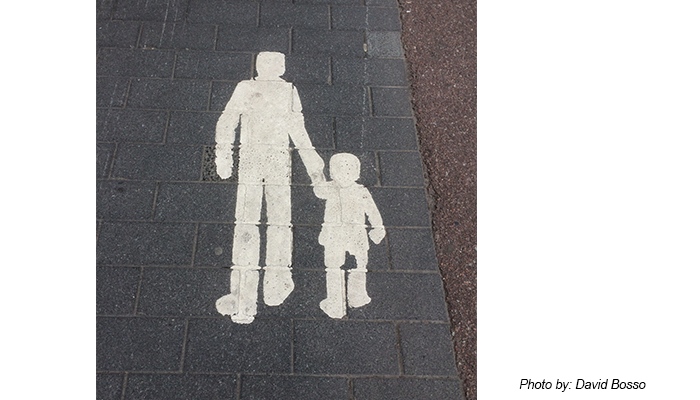
What are the lessons the U.S. should take from Finland and its high-performing students? Visit Helsinki, as I did with a group of U.S. educators, and you will literally step on one such lesson on every other street corner.
The Finns, almost literally, hold hands and move as one.
Finland’s narrative is the remarkable education story of our time. Like the South Koreans and other Asian nations, they have ranked at or near the top of the Programme for International Student Assessment (PISA). But unlike them, Finnish kids are demonstrating that strong achievement is possible without extreme investments in time and tutoring. (See Amanda Ripley’s book for more.) Finnish students typically have shorter school days, frequent recess breaks, and comparatively light homework. As a nation, Finland has not obsessed over its schools or its children. It has simply carved out its own pragmatic, steady path to extraordinarily high achievement—at least as measured by PISA. How have they done it?
Judging from what we saw and heard during our visit, the story of what Finland did can be told fairly simply—and it is an important story for Americans to absorb. Equally important, though, is understanding what the Finns haven’t done—yet.
It would be no more plausible for an army general or business executive to become a district superintendent in Finland than it would be for them to become a surgeon.
The Conditions Behind the Finnish Education Model
The Finns seem to be wired for pragmatic, purpose-driven pursuit of the social objectives they view as paramount. Their governing system doesn’t zig and zag the way ours does, nor is it too frequently straitjacketed by hardball politics. Said one educator with us on the trip: “The whole week, I had the impression that everyone we talked to, from policymakers and advocacy organizations to principals and teachers, were all on the same page. They all agreed, more or less, on where their schools are and where they need to go.”
This pragmatic approach to politics and education policy is enabled in part by the size of the Finnish ecosystem—an economy roughly the size of Connecticut’s in a land mass about 4/5 the size of California—and by the relative homogeneity of that populace (though it is becoming more diverse).
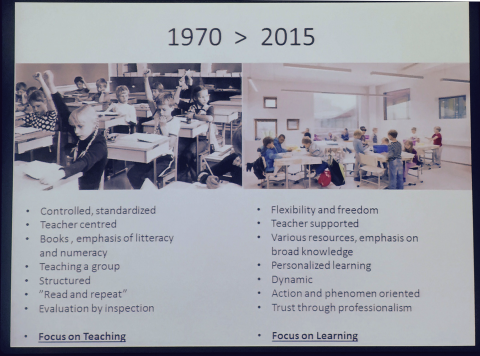
Finland's transition from its 1970s-era system to its current system (from a slide presented by the Finnish ministry of education)
The Choices That Set Finland’s Schools Apart
But all of that is essentially true of Norway, next door, which—following an approach to public education somewhat like that of the U.S.—is nobody’s poster-child for excellence in achievement. The Finns have made several crucial choices that appear to have contributed to their results. As a nation, they:
Committed years ago to a net of social support for its citizens that makes the gap between upper and lower levels among the narrowest in the world. Poverty levels are extremely low. Education is free, with no tuition fees for Finnish students, from preschool through higher education. Schools also provide free meals, health services, counseling, and special learning support to every student. Their schools do not need to organize themselves to serve the extreme diversity of readiness and out-of-school dysfunction that many American educators must address. (That’s the other poignant message we travelers all read in the handholding streetcorner iconography in Helsinki.)
Deliberately set out to turn teaching into a sought-after profession with all of the attributes of medicine and the law. In the U.S. we might wring our hands over this one, but everything we have done over the past thirty years to scale standards-based reform has diminished, not enhanced, teachers’ status and the role they play in shaping the system and learning models in which they work. The Finns, by contrast, eliminated eighty percent of their teacher college programs near the start of their push to improve their schools in the mid-1970s. Teaching became very selective; the remaining nine colleges now admit just one out of ten applicants. Teachers are accorded deep respect as professionals of their practice. Their teacher education is a research-based master’s degree focused on learning science. What draws them to the profession is teacher autonomy, respect, and working conditions, including far more time than most American teachers have to plan lessons, collaborate, and work with individual students. They are relied upon to conduct research in their classrooms and to collaboratively analyze results. They are not paid substantially more than their U.S. counterparts—but they benefit from the wide range of Finnish social services (and aren’t looking up at vast differences in compensation between them and other professions).
Developed a system and culture shaped by pervasive trust. When the Finns started their push, their system looked somewhat like ours, with strong, mandated controls on practice and curriculum. (Our controls are the consequence of accountability driven by annual testing.) In the late 1980s, as teachers and schools developed substantially stronger capacity through the reforms of the previous decade, those controls were relaxed. Thirty years later, the nation’s education system is designed, managed, and implemented by the education professionals. It would be no more plausible for an army general or business executive to become a district superintendent in Finland than it would be for them to become a surgeon. Moreover, there is no standardized testing during basic education beyond the assessments teachers use in their own classrooms. After that, students choose between general upper secondary education, which ends with the matriculation examination, and vocational education and training. The exam carries consequences, but—as we heard several times during our visit—there “are no dead ends in the Finnish system.” Vocational qualifications also open the door to higher education, including universities of applied sciences, and students can always double back toward the pathways they want to pursue in a system built around lifelong learning.
Extend that trust to students. A defining feature of the Finnish model is that the trust placed in educators extends to kids. Students move through nine years of basic education together, with no academic tracking, on the understanding that they will develop in different ways and at different paces. And because teachers know their students well, they can spot when someone is struggling and step in early, rather than waiting for standardized tests to flag the problem.
Up to age seven, Finnish children are encouraged to play. Playful learning is the watchword. Maria Montessori and John Dewey would applaud.
What Finland Hasn’t Done—And What’s Next
Many of the American educators I traveled with (our excellent visit was organized by EF Education Tours) remarked to me on what they didn’t see on our trip. That was inventive pedagogy, at least during the years we associate with third grade through twelfth. Up to age seven, Finnish children are encouraged to play: formal basic education doesn’t begin until then, following early childhood education and care and a year of pre-primary education at age six. Play-based learning is the watchword. Maria Montessori and John Dewey—along with most learning scientists and brain development researchers—would enthusiastically applaud. After that, Finnish classroom practice doesn’t appear to diverge all that much from the same traditional, textbook-driven, teacher-centered, content-delivery approaches that have been the stock in trade of our first century of public schooling. (The Finns do appear to put more emphasis on learning the hard sciences through constant experimenting in the labs.)
The Americans I traveled with generally felt that they are seeing more inventive pedagogy on our side of the pond: more experimenting in school design, deeper levels of engagement around project-based and student-centered learning. Of course, this was a self-selected group of internationally curious educators and their perspectives may not perfectly reflect the norms.
But even this group couldn’t help but wonder whether the Finns will quickly outstrip us in the pedagogical arena, too. As Finland’s PISA results began to slip, particularly in math compared to Asian countries, the nation’s response was far removed from the clamor for stepped-up accountability we would likely see in the U.S. under such circumstances. Instead, Finland made a national commitment, in their handholding “all-in” way, to what they call phenomenon-based education—essentially, organizing learning around real-world topics rather than only around subjects. They cite climate change as an example. Under the national core curriculum, issued by the Finnish National Agency for Education, schools are required to include multidisciplinary, phenomenon-based learning modules alongside traditional subjects, building them into their local curricula. Students learn math, literacy, science, social studies, and a range of 21st-century skills by exploring real-world phenomena and considering solutions to societal challenges.
[Editor’s note: Finland’s PISA scores have continued to decline in later assessments, though the education system in Finland still performs above the OECD average.]
An Educational Grand Slam
With these reforms, Finland is aiming for the equivalent of a human capital development four-bagger:
Extensive social welfare supports
An effective philosophy on all-important early childhood
An extremely capable corps of teachers who are regarded as top professionals; and
Active-learning designs for schools and pedagogy that reflect what we now know about how people learn best, and are deliberately aimed at building the skills and dispositions that young adults need in order to thrive in the 21st century.
The Finns generously say they learn quite a bit from us. We are quite good, they say, at generating points of light. Combine the Harlem Children’s Zone, the emerging set of public Montessori schools around the country, and High Tech High (which prepares many of its own teachers through its accredited teacher college), for example, and you’d have a boot-strapped, entrepreneurial, U.S. version of that grand slam. But… making sure that most children in our country benefit from those approaches would require an ability to make hard choices, uproot traditional structures and operating habits, and learn to practice a high degree of trust throughout our education system.
Can we do that? Americans used to believe we could accomplish just about anything we set our minds to achieve. That’s been a hallmark of our national character. Figuring out how to work our way back to that national mindset might be a good place to start.
Andy Calkins
Senior Partner, Strategy & Development, LEAP Innovations
As senior partner for strategy and development for LEAP Innovations, Andy Calkins helps to lead strategy development and philanthropic partnership for the organization. Follow Andy on LinkedIn.