Five Lessons from Arkansas on Small-Group Math Instruction and Student Proficiency

Samantha du Preez
Director of Marketing & Community Engagement
Modern Classrooms Project
Topics
We’ve all had the experience of truly purposeful, authentic learning and know how valuable it is. Educators are taking the best of what we know about learning, student support, effective instruction, and interpersonal skill-building to completely reimagine schools so that students experience that kind of purposeful learning all day, every day.
What a year of classroom visits and summer training across eight Arkansas districts taught us about how effective educators move students from good to great.
Arkansas math scores are on the rise. On the 2026 ATLAS assessment, 44.2 percent of students scored proficient in mathematics, up from 36.4 percent in 2024. Fourth grade climbed past 47 percent. Algebra gained ten points in two years. After years of flat results, something is working. Look closer and a pattern emerges: in every single grade tested, the largest group of Arkansas students fall into level 2: students sitting just below proficiency. These students may not be proficient yet, but they are close.
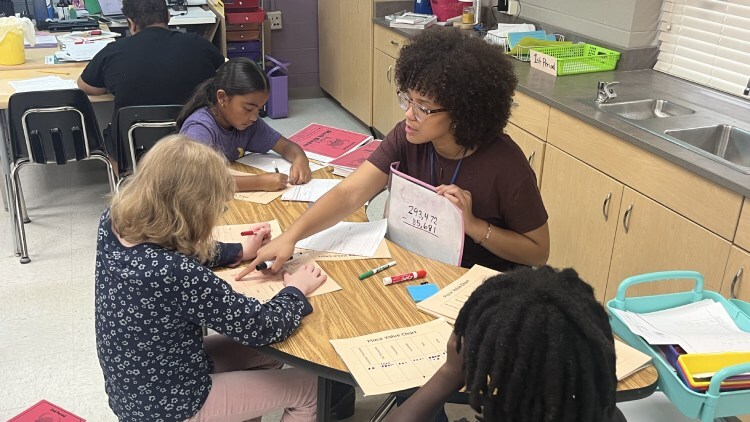
Helping these students become proficient in math is a specific instructional problem. Buying a new curriculum is too much, but giving students a few more practice problems isn’t going to cut it either. And because these students are not radically behind their peers, they are also probably not appropriate candidates for intensive intervention. These students need targeted support to fill in specific gaps and correct misconceptions that are preventing them from reaching true proficiency. They need somebody to sit with them and provide personalized support to unlock learning at the next level.
On the surface, we know why this kind of support is so rarely implemented—educators are attempting to support full classes with high ratios, attempting to stick to the pacing guide, and dealing with perennial issues like behavioral challenges and absent students. Moving every student toward proficiency is the goal, but in practice? Most educators are just trying to make it through the lesson. In that paradigm, getting every student what they need becomes a logistical nightmare.
Every math teacher knows their students need additional support to reach proficiency. How do educators deliver that support to each student while still supporting the class as a whole?
A Mastery-Based Model that Offers Individual and Small Group Support
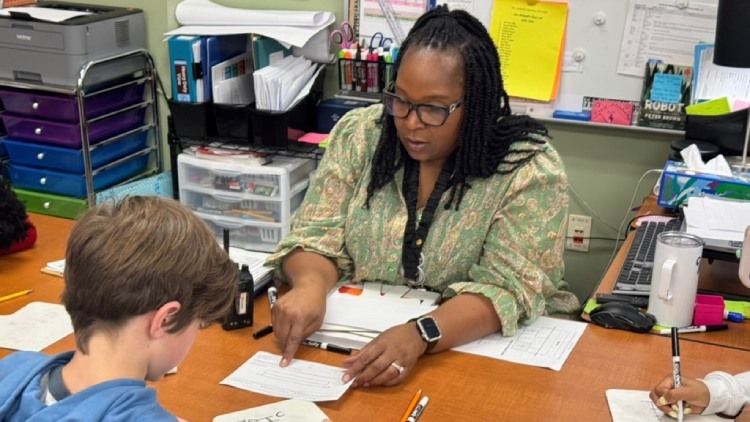
At Modern Classrooms Project (MCP), helping educators support every student in their classroom is our bread and butter. We started by laying the groundwork in Conway, Mayflower, and Little Rock, training 65+ Arkansas educators in the summer of 2025 in Modern Classrooms Project’s mastery-based model. Prior to the training, we asked educators a few key questions about their work and their classrooms. Nearly four in five educators were confident with the curriculum, and yet fewer than one in three were confident they could meet their students’ needs. These weren’t disengaged teachers, either. They reported spending a median of half an hour planning a single math lesson, and some were spending as much as two hours. This points to a specific problem: either the curriculum isn’t effectively supporting all students, or educators don’t know how to unlock that curriculum for everyone.
A year later, in June of 2026, we ran our largest Arkansas training yet: 96 educators in Springdale, 89 percent of whom had never encountered this model before. Before the training began, we asked them to rate their confidence across the core skills of math instruction. Their lowest score, the thing they felt least equipped to do, was providing one-on-one and small-group support.
That was the picture of teaching and learning that was painted well before Modern Classrooms arrived on the scene: teachers who knew their curriculum, who were spending real hours planning with it, and who did not believe they could give their students the individual attention they needed. After a year with Modern Classrooms training and support, the data paints a very different picture—we’re seeing educators spend far more time with students individually and in small groups, and it’s making a difference with those that are struggling the most. Here’s what we learned in the process.
Lesson 1: Build the conditions that make differentiation doable
In theory, every educator understands the value of differentiation. But in practice, that differentiation isn’t always effective. The, ahem, differentiating factor? The systems that keep learning flowing forward without constant teacher intervention.
As one fourth-grade Springdale teacher at Westwood Elementary said: "I was already pulling small groups during math, but I wasn't able to reach ALL my students. I didn't get to meet with students who needed extension and I wasn’t always able to quickly check in with those that needed it."
This teacher is skilled in math instruction, committed to her students, and understands effective pedagogy. The only thing missing was a structure that allowed students to work through content at their own pace and for her to connect with students individually and in small groups.
After two days of training, Springdale teachers posted their largest confidence gain in planning a self-paced unit, with their second largest gain in facilitating student discourse. While neither of those is a small-group skill, both are necessary conditions that make small-group time possible.
In the fall, only a few months after their initial training on the self-paced, mastery-based instructional model, we visited Conway classrooms and found 83 percent of their educators were providing small-group or one-on-one instruction. On average, they were doing it for 24 minutes of every class period—nearly half the class period.
Takeaways
For teachers: Before you decide you can't differentiate, figure out what systems would enable more effective differentiation for your students. Can you coach your students toward independent learning time for specific activities? What structures could you build to create more teacher time?
For leaders: Stop framing differentiation as a capacity or skill your teachers lack in PD and observations. What structures can you create in the school day that give educators the time to work with students one-on-one?
Lesson 2: Don’t let skepticism supersede strong instruction
We expected skepticism during our summer trainings, and oh boy, we got it. If that was the last word on Modern Classrooms Project, we would have gone the way of the dinosaur already.
We expect a good amount of criticism and pushback when introducing this model to teachers. And over the course of each training, we see that change. Sometimes, from outrage to openness, sometimes less dramatic. And that would be a dull thing to write about if it weren't so consistent.
Molly Cash, a fifth-grade teacher at Monitor Elementary in Springdale said: "I think the emphasis on student independence and autonomy made me realize how much control I try to have on each student, which usually translates to students feeling like they need to check everything with me, which became difficult for me to handle."
Juan Manzanares, a fifth-grade teacher at Harp Elementary said: "I realized that I want to be the one to support my students in math. That is where my resistance came from initially."
Haley Storms, who teaches eighth-grade math at Mayflower Middle School said: "Prior to this training, I was under the assumption that the teacher wouldn't have as much control and influence on instruction, but that is not the case. I can still provide guidance in an impactful way."
The process of supporting numerous Arkansas schools really hit home the idea that popularity doesn’t always equate to good pedagogy, and that the inverse is also true. And that skepticism comes from a good place: educators have strong feelings about the work they do because they know it matters and they are fiercely protective of their students. But we shouldn’t let that skepticism keep us from providing the kind of instruction that our students need.
Takeaways
For teachers: you may be a strict critic of pedagogy, but keep your mind open to the possibilities that can strengthen your instructional practice. Be discerning with what you bring in front of your students, but also be sure to use the data to inform your understanding of its efficacy.
For leaders: Don't screen your cohort for enthusiasm. The teachers with the strongest instincts about their students are often the most resistant, for good reasons, and they can convert into your strongest implementers.
Lesson 3: The most persuasive person in the room teaches down the hall
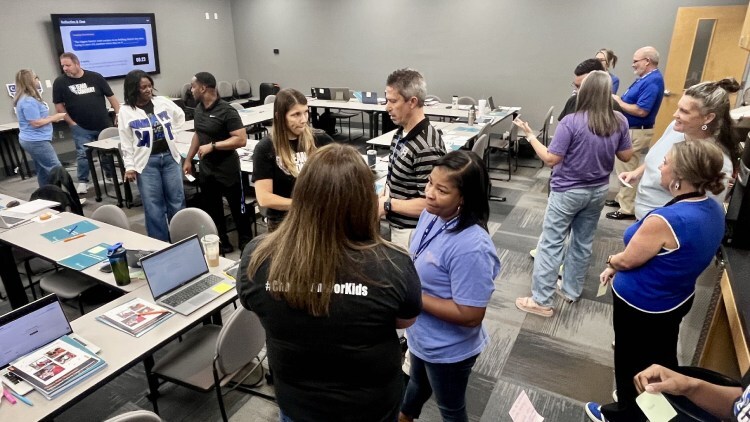
At our second Conway training this year in July, a Conway educator, someone who was already running the model in her own classroom (in that district, with those students), supported the training as a speaker. The ratings of that particular training were among the highest we saw in the entire state.
Jazmin Carranza teaches ninth-grade math at Southwest Junior High in Springdale. She said, "In my math team, we discussed issues we were having, how to remediate students and how to extend those who already get it. This training answered both questions. I wish my whole math team could have joined this training this summer."
Another Conway educator called out the training videos that take viewers inside actual classrooms and show the challenges and successes teachers were having with a mastery-based approach to learning. She said, "One of the parts of the training I enjoyed the most was watching the video testimonials from real teachers who have implemented the MCP model in their own classrooms." The lesson has been clear—give educators real examples of good teaching. Let them see it, live if you can.
Takeaways
For teachers: Some of the highest leverage support and growth you will experience come from the teachers around you. Seek out their expertise and stay open to suggestions that can help you improve your craft.
For leaders: The cheapest high-yield professional development available to you is a bus. Mayflower's implementation is now strong enough, and their ATLAS data is showing the growth it’s supporting, that other districts are sending leaders and coaches to visit and see the model in action.
Lesson 4: Leadership involvement creates real follow-through
At Lakeside in Chicot County, both the principal and the superintendent attended the full training and told us they planned to walk classrooms during the year.
In Fayetteville, district leaders didn't observe from the back. They joined the teachers during the Mastery Check sorting activity and did the work alongside them.
In Springdale, leadership was present for the largest training cohort in the state.
And in one district we visited in the fall, where district leadership engagement was limited and teachers described themselves as overwhelmed by competing initiatives, adoption was partial and inconsistent, with almost no classroom reaching consistent practice.
In yet another district, the high school assistant principal attended and became a vocal advocate for secondary implementation. The high school principal declined to attend, and high school buy-in remains an open question.
Squabbles over whether top-down initiatives or bottom-up movements are more effective have missed something crucial. Namely, that both are needed: the buy-in of boots-on-the-ground classroom teachers and administrator support that breaks down systemic barriers to implementation.
Takeaways
For teachers: Engage your principal in your problems of practice and use the data to drive those discussions. When your leader sees the impact of your approach, they are more likely to support it, invest in it, and support other educators in learning about it.
For leaders: Attendance is the intervention. You convey the importance of new initiatives with your time and attention. Your teachers are more likely to put in the work when they know that work will be seen and will also contribute toward their professional growth.
Lesson 5: Measure both implementation and student impact
How many professional development sessions have you attended where the learning and the impact felt fleeting? Maybe the speaker got you fired up, maybe you learned a new technique, maybe you got a free resource at the end. This is not impact and may very well be a waste of district dollars. These trainings might boost morale or confidence, but students end up missing out on the benefits altogether.
A Modern Classrooms training isn’t like that—across every Arkansas classroom we observed, we saw educators adopt the materials fast. In Conway, at least 89 percent were using our videos, guided notes, Mastery Checks, and practice problems. They were using the interventions we provided and trained them on. This was a measurable change in teacher behavior.
When we visited Mayflower last fall, educators were successfully supporting students with highly differentiated lessons and personalized intervention. So what was the impact? Tonya Hogue at Mayflower Elementary said: "My students are confident in their learning and if they are unsure, they actually ask for help. That doesn't happen in traditional teaching."
Behavioral change acts as a precursor to shifts in the data. These are the early indicators of success while educators wait on test results to back up what they already know: their students are moving toward mastery.
Takeaways
For teachers: Consider the qualitative and quantitative impact of instructional shifts on the student experience and student achievement. How are you measuring success?
For leaders: How are you measuring the efficacy of the PD sessions you provide? How do you determine if educators actually implement their learning? How are you measuring the impact on student learning?
A Year of Lessons from Arkansas Math Instruction
Complete transformation isn’t possible in a year. But the year one data from eight Arkansas districts shows something more modest and perhaps more useful: educators trying, learning on the job, getting some of it right. Nothing is golden in the classroom (except maybe a moment of silence!), but these educators are making real instructional shifts that better support all learners.
Students who are within reach of proficiency but not quite there yet need a few more minutes with a teacher who knows exactly where they’re stuck. A year in Arkansas has been about building classrooms where those minutes exist. The Modern Classrooms model and training helped provide systems that kept the rest of the room learning, skeptics who became advocates, colleagues who acted as mentors and leaders, leaders who showed up, and an honest look at whether any of it changed things for kids.
Arkansas has already shown its scores can move. The next gain won’t come from asking teachers to do more. It will come from giving them the time and structure to reach the students who are almost there.
Note: Modern Classrooms Project is a paid member of the LEAP Innovations EdTech Design Collective.
Credit, all photos: Modern Classrooms Project.
Samantha du Preez
Director of Marketing & Community Engagement, Modern Classrooms Project
Samantha du Preez is a former educator with experience teaching in California, Arizona, and South Korea. She earned her bachelor's in English and journalism from the University of Arizona and her master's in curriculum and instruction from the American College of Education. Although she hasn't been in the classroom for several years, she continues to empower educators, improve access to quality educational opportunities, and impact education.