Inside NGLC's Regional Funds for Breakthrough Schools

Sarah Luchs
Program Officer
Next Generation Learning Challenges
in Columbus, OH
Topics
When educators design and create new schools, and live next gen learning themselves, they take the lead in growing next gen learning across the nation. Other educators don’t simply follow and adopt; next gen learning depends on personal and community agency—the will to own the change, fueled by the desire to learn from and with others. Networks and policy play important roles in enabling grassroots approaches to change.
How six regional partners helped NGLC grow a national network of breakthrough schools, and what their work reveals about scaling personalized learning.
Roughly one year after launching the Regional Funds for Breakthrough Schools, NGLC added 49 next gen schools selected by its six regional partners to its national cohort of 41+ schools, growing the portfolio to 90 (press release).
Let’s take a look at the larger context behind that expansion and the role regional partners play in growing next gen learning. They help surface and support school teams, build a next gen mindset among educators, and open the door to redesigning traditional district schools.
What Are the Regional Funds for Breakthrough Schools?
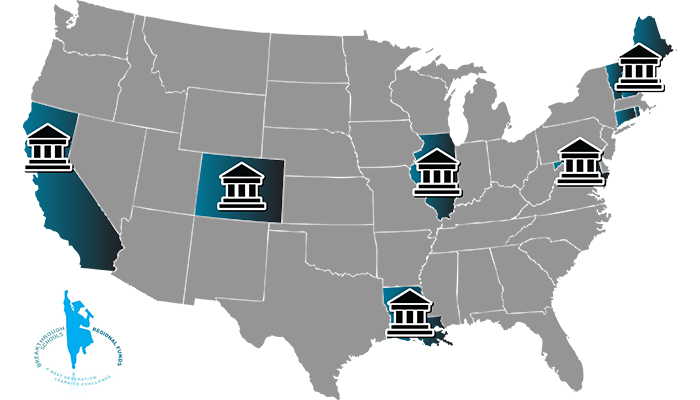
The Regional Funds for Breakthrough Schools was a $25 million, first-of-its-kind national initiative to establish regional hubs of K-12 innovation. Through six community-based partner organizations, it awarded school innovation grants to local educators whose innovative school models incorporated leading principles of personalized, blended, and competency-based learning.
The six regional partners were:
CityBridge Foundation, Washington, D.C.
The Colorado Education Initiative, representing a coalition of three Colorado school districts and the Colorado Department of Education
LEAP Innovations, Chicago, Ill.
New Schools for New Orleans, in partnership with the Louisiana Recovery School District, the Orleans Parish School Board, Educate Now!, and 4.0 Schools
New England Secondary School Consortium, coordinated by the Great Schools Partnership
Rogers Family Foundation, Oakland, Calif.
Breakthrough schools come in many forms, from new or redesigned charter and district schools to existing public schools that make significant changes to their design, operation, or instructional practice.
At least 1.5 years of growth annually in math and English/language arts, an ambitious but necessary goal for students who are behind in specific subject areas or grade levels
A 90 percent high school graduation rate
At least 80 percent of graduating students meeting college readiness benchmarks and enrolling in college
Why Was the Announcement Significant?
The announcement meant 29 more schools were actively working to become next gen, personalized learning schools, with another 20 to follow. By fall 2016, that expansion would give 25,000 students the opportunity to learn in ways designed specifically around their individual needs and interests and, as a result, be better prepared for the changing demands of college, career, and community life.
Why Does That Matter?
“The strategies that defined excellence yesterday will likely not generate excellence tomorrow. Our schools have to be more fluid and proactive in meeting the changing needs of society and of the students they serve.”
Every parent wants their child to benefit from an excellent education. But the strategies that defined excellence yesterday will likely not generate excellence tomorrow. Our schools have to be more fluid and proactive in meeting the changing needs of society and of the students they serve. That’s a different expectation for many schools. Next gen strategies embrace that kind of change, so next gen schools help define the ever-rising bar of excellence and prepare students to meet it.
Prior to launching the regional funds, NGLC funded 41+ innovative school models nationally. These schools reimagined learning environments, used time differently, differentiated teaching roles, and designed more applied and personalized learning experiences. Their charge was to rethink school as we know it and provide proof points from which others could learn. The cohort of 41+ schools was very diverse, yet collectively the schools acted as a north star to help inform and guide interested educators and others committed to the future of learning (video).
NGLC models were not alone in embracing new forms of teaching and learning, yet the total number of “breakthrough” schools in the U.S. was relatively small, so ensuring access to next gen learning for every student (part of NGLC’s vision) was an obvious equity issue. It raised the question, “How do we accelerate next gen adoption (broadly defined)?” This is where regional partners play an instrumental role.
How Regional Partners Help Scale Next Gen Learning
The most direct way regional partners are contributing to the growth of next gen learning is in the number of school teams they help surface and support through implementation (and by pairing local and national expertise and education innovation funding). Prior to CityBridge Foundation becoming a partner, for example, NGLC received only three applications from D.C. across five different national RFP cycles and funded just one school, Ingenuity Prep. Due to the foundation’s efforts as a partner, that same D.C. ecosystem generated 42 applications (23 in the pilot round and 19 in the first cycle), of which 13 were directly funded. The same trend emerged across all six sites. Combining local networks and intensive support for applicants with national expertise and selection processes stimulated strong interest in next gen learning.
Another way partners help scale next gen learning is by nurturing a culture of innovation and developing a next gen mindset among early adopters. Proposal workshops took the shape of modified communities of practice, and partners worked hard to attract early adopters—educators in both charter and district settings who are motivated to learn and do more. Engagement in these learning communities provides an important sense of shared identity (as change agents) and agency (permission and choice to take action). The learning agenda often includes design thinking, in-person and/or virtual exploration of NGLC’s national models, and core elements of personalized learning such as competency-based progressions, blended learning, or project-based approaches driven in part by the learner’s interests. Edtech meet-ups, integrated learning platforms, and other digital tools are also showcased. As a result, early adopters ignite or reactivate their passion for learning and, with their teams, generate promising visions for locally designed breakthrough schools.
What Other Insights Can You Share?
A subtle but potentially powerful scaling effect appears to be hidden in the development of the next gen mindset. In the course of discovering next gen learning, participating educators develop this new way of thinking, which, like a lens, enables them to see a different set of possibilities for students and schools; so, even when their school proposal is not directly funded by the regional partner, they remain committed to new ways of teaching and learning and stay connected to the sources of inspiration and community that refresh and challenge them. In that regard, regional partners influenced many more schools and educators than is reflected by the number of their grant awards.
The notion of developing new mindsets speaks to the important role of adult learning in facilitating classroom and school-based transformation. Adopting the technical aspects and procedures of a new school model or technology alone won’t generate different conditions or results. Effective teams understand the motivations behind the changes they initiate, including what problem they’re solving and why it matters. They themselves live up to the tenets of the personalized learning model they seek to bring to their students. They adopt entrepreneurial approaches to the work, using rapid prototyping, and solicit direct student and community involvement in reworking their designs.
These practices introduce a different cultural norm to traditionally prepared educators. Partner-designed workshops and learning communities drew on carefully curated resources from the provider marketplace—strategy and design support centered on next gen learning models, led by organizations such as 2Revolutions, Mastery School Design, 4.0 Schools, Alvo Institute, Education Elements, Blueprint Educational Consulting, and the Great Schools Partnership (an expert on competency-based learning and itself one of the regional partners). Partners facilitated a learning experience that wasn’t readily available elsewhere, addressing a niche need among early adopters.
Finally, regional partner school selections produced a large number of proposals for redesigning existing schools in traditional district settings—work that is notoriously complex and challenging. That’s important, considering that the majority of NGLC’s national models were charter school new-starts (with significant operating autonomy), while the majority of U.S. students are enrolled in traditional district schools, many of which have yet to reimagine learning. In this regard, you could say regional partners are pioneers, helping all of us understand the strategies and types of support best suited to in-district school redesign. By developing the capacity and untapped potential of educators in traditional district schools, and engaging schools in networks rather than one at a time, regional partners can help many more students and communities benefit from next gen learning.
What Came Next for NGLC and the Regional Funds?
NGLC focused on resource- and tool-creation and community-building supports for the new cohort of schools as they implemented their designs over the following two years. The goal was to support more Regional Fund-style efforts in more cities and regions across the country, and to keep sharing lessons learned from the partners themselves.
NGLC is now merged with LEAP Innovations, one of the original six regional partners, continuing this work to expand personalized, student-centered learning across the U.S.
Sarah Luchs
Program Officer, Next Generation Learning Challenges
Sarah Luchs coordinates K-12 grant-making strategies, investing in promising educators and the learning designs that define Breakthrough Schools.