Student Rights Must Travel with Students
Kelsey Ortiz
Founder and Director
Inclusive Digital Era Collaborative
Topics
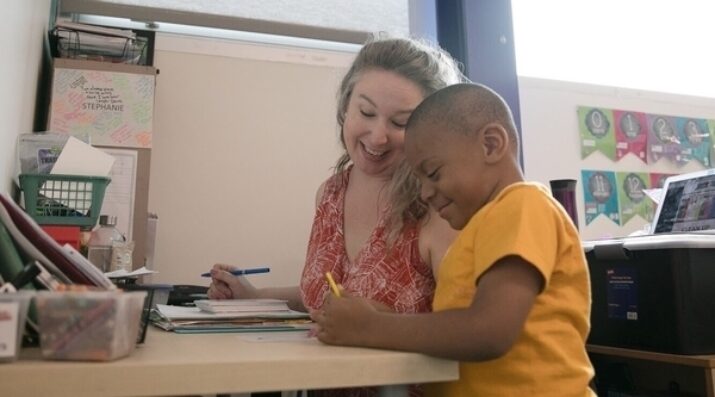
Together, educators are doing the reimagining and reinvention work necessary to make true educational equity possible. Student-centered learning advances equity when it values social and emotional growth alongside academic achievement, takes a cultural lens on strengths and competencies, and equips students with the power and skills to address injustice in their schools and communities.
As learning opportunities expand beyond traditional school buildings, student rights for educational access and protections need to follow them.
As educational opportunities continue to expand beyond traditional school buildings, we must ask ourselves an important question: Are students' rights traveling with them?
For more than a decade, my work has focused on understanding how students with disabilities experience educational settings where instruction is delivered through technology, remote learning models, virtual schools, and other alternative environments. While these settings have created new opportunities for access and flexibility, they have also exposed significant challenges in ensuring that students continue to receive the protections guaranteed to them under federal law.
The concern extended far beyond online learning itself. The real issue was whether students' rights were following them into alternative educational settings.
My journey into this work began with the Center for Online Learning and Students with Disabilities at the University of Kansas, one of the first major investments by the U.S. Department of Education's Office of Special Education Programs in 2014 to explore the implications of online learning for students with disabilities. At the time, virtual learning was expanding rapidly, and policymakers, educators, and researchers were grappling with a fundamental reality: we don’t know what we don’t know.
Through a series of research studies, I examined how all 50 states and eight U.S. territories addressed the core principles of the Individuals with Disabilities Education Act (IDEA) within emerging virtual learning environments. The findings revealed considerable variation in how states approached student protections and highlighted important questions about accountability, access, and implementation.
What became increasingly clear was that the concern extended far beyond online learning itself. The real issue was whether students' rights were following them into alternative educational settings.
The Individuals with Disabilities Education Act, along with Section 504 of the Rehabilitation Act and the Americans with Disabilities Act, provides a powerful framework for protecting students from discrimination and ensuring access to educational opportunity. These laws establish shared responsibilities among states, school districts, educators, and families to ensure that disabilities do not become barriers to achieving a student's full potential.
The challenge is that educational practice often evolves faster than policy.
Today, schools are experimenting with a growing range of instructional models. Technology-driven learning environments, virtual schools, hybrid programs, microschools, charter schools, and other alternative settings are becoming increasingly common. Yet many of the policies designed to protect students were written for educational systems that look very different from those we see today.
This creates policy gaps.
In some cases, safeguards that affect students are embedded in different areas of state law and do not align neatly with education policy. In others, state education agencies rely on local districts to develop their own approaches without providing sufficient guidance. There are also difficult conversations about resources and funding. Explicit protections often require investments in personnel, training, oversight, and support services. Too often, concerns about cost can delay or complicate conversations about strengthening student protections.
The result is that families, educators, and administrators are frequently left navigating unclear expectations while trying to ensure students receive the support they need.
Despite these challenges, I remain hopeful.
Every student deserves an educational experience that not only meets their needs but also honors their rights.
One reason for my optimism is that many of the legal and procedural safeguards that protect students and families are still in place. While recent changes at federal and state levels have created uncertainty, important mechanisms for accountability and advocacy continue to exist.
I am also encouraged by the emergence of a new generation of advocates. Across the country, highly skilled professionals with expertise in education policy, disability rights, and systems change are stepping into new roles and finding innovative ways to support students and families. Their energy, creativity, and commitment offer a powerful foundation for future progress.
Additionally, we are gaining a deeper understanding of how children learn in technology-mediated environments. New research is helping us better understand both the opportunities and the limitations of technology-driven instruction, including its potential impact on cognitive development, engagement, and well-being. These insights can help us make more informed decisions about how educational systems should evolve.
As we continue to innovate, we must ensure that student rights remain at the center of the conversation. Innovation should never come at the expense of equity, access, or legal protections. Every student deserves an educational experience that not only meets their needs but also honors their rights.
The future of education will undoubtedly include new learning models, new technologies, and new approaches to teaching and learning. Our responsibility is to ensure that the protections established through decades of advocacy and legislation evolve alongside those changes.
Students may learn in different places and through different methods, but their rights should remain constant wherever learning occurs.
Listen
NGLC is grateful for our collaboration and partnership with EDU Café Podcast that brings fresh voices and insights to the blog. Listen to the full episode of the podcast that inspired this article.
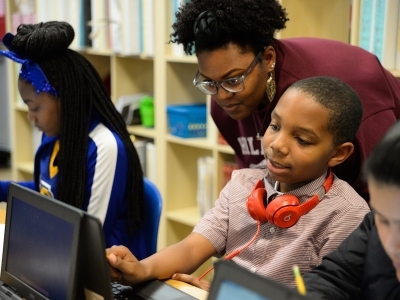
Photo at top courtesy of Two Rivers Public Charter School.
Kelsey Ortiz
Founder and Director, Inclusive Digital Era Collaborative
Kelsey Ortiz is the founder and director of the Inclusive Digital Era Collaborative (iDEC) and supports state efforts to have deeper policy discussions around digital learning and equal access for all students.